Welcome to "Ask the Expert," your opportunity to receive advice from some of the nation’s top information and materials management experts. Periodically we’ll feature a new answer on a hot business issue--from new technology to process improvements to ways you can capitalize on information assets.
Q: We are a small, private healthcare clinic in
need of implementing processes to meet HIPAA compliance guidelines.
Where do we start?
A: Understanding how HIPAA impacts your organization, as well as what
steps you need to take to comply, is key to eliminating liability and
noncompliance. Begin by familiarizing yourself with HIPAA guidelines,
such as the type of personal health information that needs to be protected.
Visit http://aspe.os.dhhs.gov or www.hipaa.com for detailed information.
Evaluate internal operations to understand the impact HIPAA will have
on your current practices. Review and document your security policies
and procedures. Develop a privacy plan and implementation procedures
that include securing patient records that contain individually identifiable
health information. Designate individuals and vendor partners to oversee
plan implementation and provide the products and services necessary
to comply. Finally, inform patients of their rights and the steps you
intend to take to safeguard their personal health information.
Q: We want to convert our current filing system to a color-coded,
straight numeric system. Where do I begin?
A: Begin by evaluating your file inventory, including quantity, content
and relevance. If you have a retention and destruction plan, make sure
all necessary files have been purged and destroyed accordingly. Consider
your business needs. Are you redesigning your system to accommodate
growth or is it strictly for efficiency? Take into account how often
you need to access your files and the compliance guidelines impacting
your organization. Select the appropriate file folder, color-coded label
design, and then determine label content based on straight numeric filing
guidelines. Put procedures in place to incorporate the system, including
timelines, expectations and results. Set aside time to complete
the transition without interfering with business. Consider working with
a professional who can provide the tools you need to plan and implement
your new system, including color-coded folders, label print systems,
tracking technology and more.
Q: How can I reduce the costs associated with document management
and simplify our records archiving process?
A: Implement "best practices" at the onset of the document lifecycle
process and you will create efficiencies to save money in labor and
materials. To simplify archiving, as well as the entire document management
process, consider using a filing system designed to accommodate the
storage and tracking requirements for both active and inactive storage.
This will eliminate the need to transfer files at a later date into
top-tab folders when archiving; or barcode files or boxes prior to relocation;
or create a retention inventory of archived records. If storing archive
files off-site, complete a detailed record inventory and develop guidelines
for accessing and re-filing records before relocation to reduce the
risk of misplaced or incomplete information. Also, remember to consider
your company's retention and destruction policies as you develop off-site
storage procedures.
Q: We had a fire at our office and our personnel files were subject
to water damage. How do I repair those records?
A: The first step in records recovery is determining the number of records
damaged and the extent of that damage. Fortunately, almost any wet paper-based
document can be saved with immediate and proper action. If the number
of damaged records is minimal and they are only damp or moderately wet,
you can dry them in-house by laying them out, circulating dry air and
possibly running a dehumidifier. The dryer and warmer the air, the faster
the records will dry. Remember wet records should be handled carefully
to prevent further damage. After records are dry, remove any dirt or
dust with a soft cloth or brush. To handle a large volume of wet records,
contact your local SYSTEC member to assist with the recovery. Consider
transferring personnel documents to an electronic format that can be
backed up and stored off-site as a preventative measure.
Q: My company records are primarily paper-based. What guidelines
should I follow to retain my records?
A: Retention guidelines vary within organizations and are impacted by
internal needs, as well as industry and compliance regulations. To implement
an effective retention plan, analyze your needs and determine what constitutes
a vital record. Identify legally significant documents as well as records
impacting operations. Understanding the lifecycle of your records will
help determine the length of retention. Most importantly, remember to
follow industry-specific compliance guidelines. Remaining compliant
will protect your business in case of legal action. A strong retention
plan will make documents more accessible and internal processes run
more smoothly. And remember, while your current records are primarily
paper, prepare for the retention of important electronic documents such
as e-mail.
Q: Is ISO 15489 different from other ISO standards?
A: Most ISO standards are highly specific to a particular product, material
or process. ISO 9000 deals with quality management: enhancing customer
satisfaction by meeting regulatory requirements to improve performance.
ISO 14000 focuses on environmental management: minimizing harmful effects
on the environment caused by a company's activities. ISO 15489 deals
with records management: standardizing policies and procedures to ensure
that evidence and information contained in records can be retrieved
more efficiently and effectively. ISO 15489 is not a government regulation,
but rather a standard of excellence that provides guidelines to achieve
a higher level of accuracy, integrity and efficiency in document management
practices. For more about ISO standards, visit their website at www.iso.org.
Q: As a small business owner, how do I know how long to retain my
records?
A: Every organization, no matter how large or small, should have a records
retention and destruction policy. However, retention policy requirements
vary for every organization. There are internal business retention needs
to consider as well as industry and government regulations. Becoming
compliant is vital to the health and longevity of any organization.
Compliance will help provide protection if ever called upon to produce
business records for legal reasons. Also, a healthy retention schedule
will help make documents more accessible. When developing a retention
plan, don't overlook e-mail. Organizations are conducting more and more
of their business over e-mail, and those messages are as much a part
of your vital records as paper documents.
Q: What should we do to safeguard our records from fire or other
natural disasters?
A: First, identify what vital and important records you would need to
maintain in the event of a disaster. Vital records can be defined as
those that contain information that is essential to the organization.
Examples of vital records include titles, deeds, stockholder list and
articles of incorporation. An important record is defined as one that
contains information fundamental to the organization. Examples of important
records are contracts, invoices and client files. Second, make an electronic
or paper duplicate copy of both vital and important documents. Third,
find a secure location to store all duplicates of the records offsite.
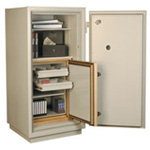
Originals should be stored onsite in a fire-safe lockable cabinet, storage
unit or fire-safe room.